


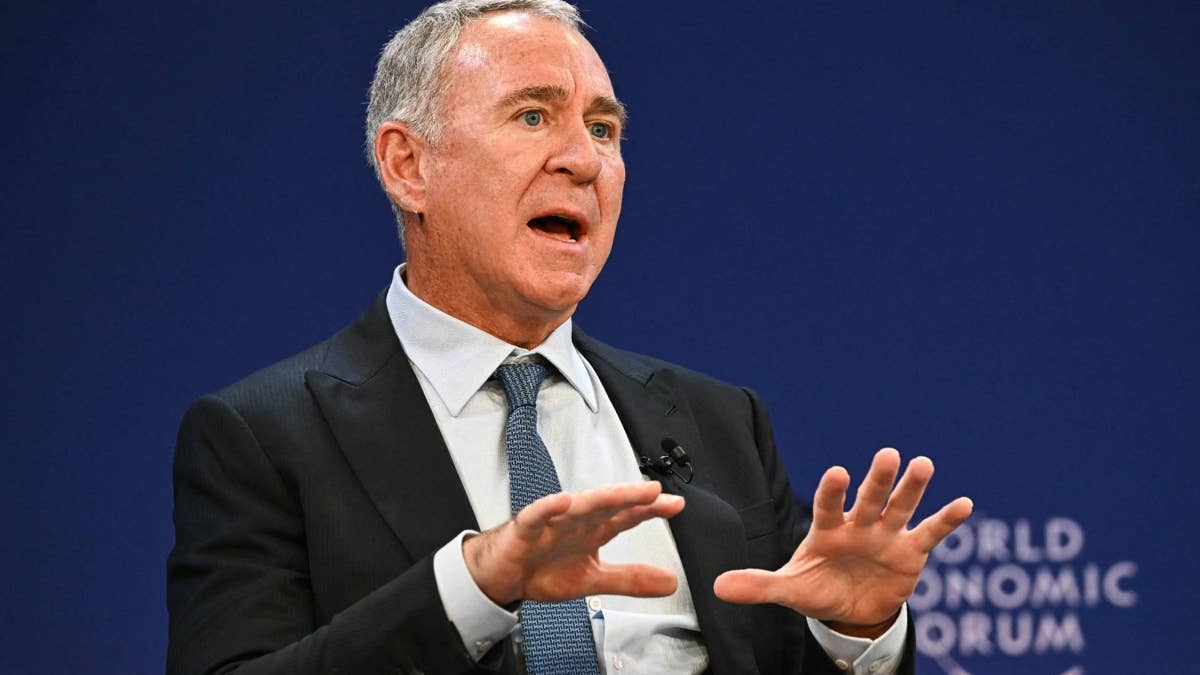

Billionaire Ken Griffin isn’t mincing words.
The legendary hedge fund manager believes a sustained closure of the Strait of Hormuz makes a global recession unavoidable, according to CNBC. He said it could turn an already hot Middle East conflict into a far-reaching economic threat.
For investors, the implications are less about tracking oil’s daily movements than about what happens when the world’s critical energy chokepoints stay clogged long enough to pressure growth, consumer prices, and business confidence.
Griffin’s stark call comes at a time when markets have clawed back much of the losses linked to the conflict, but that optimism will look a lot shakier if things linger.
Oil is still hovering over $100 a barrel, and economies relying on imported energy remain the most exposed.
Put simply, if Hormuz stays shut, the economic damage won’t stay regional for long.
Who is Ken Griffin?
Ken Griffin is arguably one of the most prolific investors over the past three decades.
He’s the founder and CEO of hedge fund Citadel, which came out of his Harvard dorm room in 1987, before its formula launch in 1990.
He also launched Citadel Securities, which eventually evolved into a full-blown Wall Street macro-shop.
In Citadel’s most recently disclosed 13F filing, the hedge fund swung for the market’s biggest winners.
MoreEconomy:
- Goldman Sachs resets oil-price bets as war rages on
- How Fed meeting impacts mortgage rates, housing market
- IMF drops blunt warning on US economy
Citadel’s Q4 2025 filing was stacked with exposure to the market who’s-whos in QQQ, SPY, Tesla, Nvidia, and Apple.
It also added heavily to Netflix, Amazon, Broadcom, Meta, and the Dow ETF. Perhaps the biggest statement was made with the fund’s bet on Amazon, which added about $2.52 billion, bringing that position above $3.2 billion. It even doubled its Nvidia stake, pushing it near $4 billion.
Moreover, Forbes pegs Griffin’s personal net worth at nearly $50.1 billion.
Citadel’s latest 13F activity breakdown
- Market value: $0.67 trillion (prior $0.66 trillion)
- Inflows/(outflows) as % of total MV: +0.52%
- New purchases: 2,088 stocks
- Added to: 5,010 stocks
- Sold out of: 2,204 stocks
- Reduced holdings in: 5,384 stocks
- Top 10 holdings concentration: 22.8%
- Turnover: 29.2%
Source: WhaleWisdom
Why Ken Griffin sees recession risk
Griffin was uncharacteristically blunt in his call about the global economy tipping into a recession if the Strait of Hormuz remains shut for an extended period.
“Let’s assume [the Strait is] shut down for the next six to 12 months — the world’s going to end up in a recession,” he said at the Semafor World Economic conference. “There’s no way to avoid that.”
Griffin describes a six-to-12-month supply shock that hits the world’s most critical chokepoints, when it is already sitting over $100 a barrel.
His logic comes down to three primary points.
- Energy shock: A prolonged shutdown keeps oil elevated, elevating costs linked to transportation, manufacturing, and power-hungry sectors globally.
- Inflation pressure: Higher crude oil feeds into fuel, shipping, and input prices, which ultimately makes inflation harder and stickier.
- Global spillover: Griffin flagged that Asia remains remarkably vulnerable, but the damage wouldn’t stop there.
A second-order effect in the world will also be in the cards, where Griffin points to “a massive shift toward alternative fuel sources, including wind, solar and nuclear.”
Why the Strait of Hormuz matters
The Strait of Hormuz isn’t just another shipping lane. In fact, I’d best describe it as a pressure valve for the global energy infrastructure.
For some color, in early 2024 and early 2025, it accounted for roughly one-fifth of the world’s oil production and consumption, according to the U.S. Energy Information Administration (EIA), and about the same share of global LNG trade.
That’s exactly why the U.S. economy is taking such a big hit, even though about 8% of its crude imports are from the Gulf region. So whenever there’s a supply shock, it results in pricier gasoline, diesel, and airline tickets on the domestic front.
The numbers show the carnage already happening.
The EIA says Brent averaged $103 a barrel in March, up $32 from February, and then briefly touched $128 on April 2.
In the U.S., diesel prices surged 50% to $5.52 a gallon, while producer gasoline prices jumped 15.7% in March.
The incredible increase is already feeding into inflation and has Fed officials in sweats. For perspective, the IMF warns that a prolonged disruption in oil near $100 would cut global growth to 2.5%, Reuters reported.
Big banks turn darker on recession risk as oil shock builds
- Goldman Sachs raised its U.S. recession probability to 30% from 25% in late March this year, citing a jittery economy amid the oil shock, sluggish growth, and fading policy support.
- JPMorgan sees a 35% chance of a recession, and markets still look complacent amid a potentially sustained oil shock that could impact demand and growth.
- Bank of America also argued that recession risk remains underpriced, laying out the case that a full-blown conflict could spill into a broader global slowdown.
- Morgan Stanley pushed its Fed rate-cut call to September from June, according to InvestingLive, arguing that second-round oil shocks will significantly weaken activity and labor markets.
- Moody’s Analytics chief economist Mark Zandi raised his recession probability to 49%, Barron’s reported, warning it could surge past 50% if oil prices remain elevated.
- EY-Parthenon Chief Economist Gregory Daco sees a 40% chance of a recession, with risks rising further if the geopolitical situation worsens, The Wall Street Journal noted.
Related: Ernst & Young drops stunning take on economy as oil jumps