


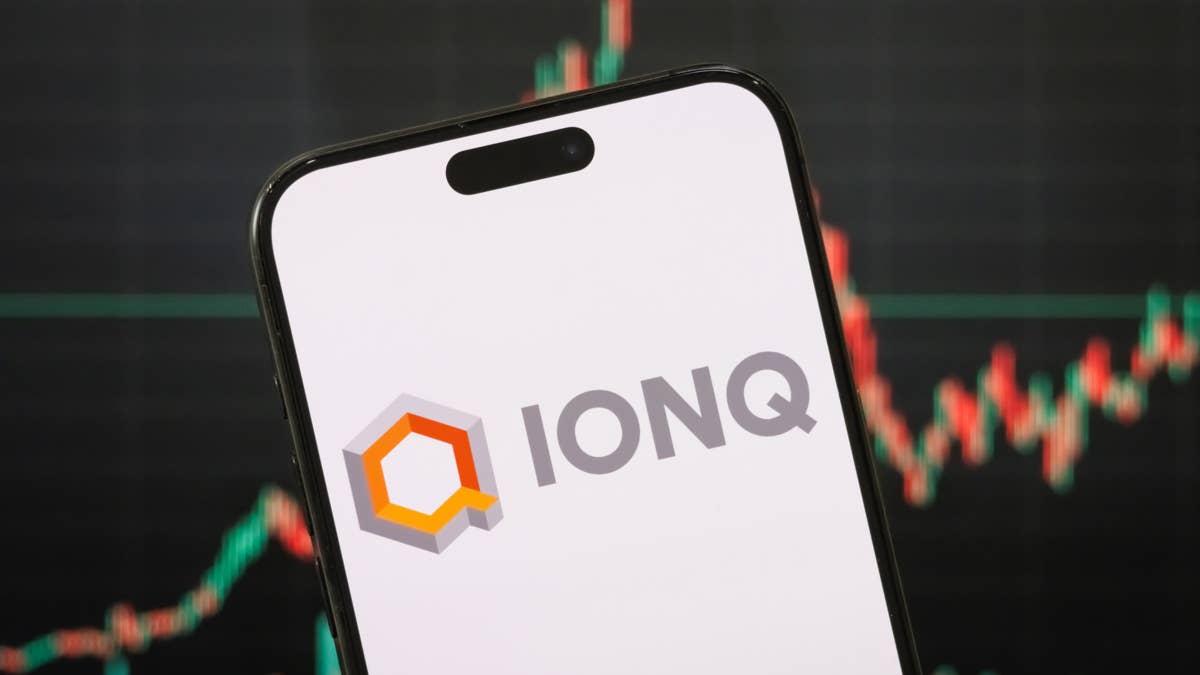

Shares of IonQ surged 20% on April 14 to $35.76 after the quantum computing company landed a U.S. defense research contract, putting the sector that has struggled for a while in the spotlight again.
IonQ said it has been selected for a program run by the Defense Advanced Research Projects Agency (DARPA), the Pentagon’s advanced research arm, under its Heterogeneous Architectures for Quantum (HARQ).
In simple terms, DARPA is trying to solve one of quantum computing’s biggest problems: Different quantum machines today are built using different technologies, and they don’t easily work together.
IonQ’s role is to help connect them, securing communication between diverse qubit species.
IonQ said it is building “a new class of networked quantum computers that combine distinct qubit types… into an interconnected, high-performance architecture taking advantage of each modality’s strengths.”
“We look forward to collaborating with DARPA to strengthen national security by developing the quantum platform which can serve as a backbone for networking and scaling quantum systems,” CEO Niccolo de Masi said.
Why IonQ stock is still far below its highs
Despite Tuesday, April 14’s rally, IonQ shares remain down about 56% from their October 2025 peak above $80.
The drop reflects a broader reset across speculative tech, especially companies tied to emerging technologies like quantum computing that are still years away from large-scale commercialization.
Investors have also become more sensitive to the long timelines to profitability and the current limited revenue, as well as rising pressure among high-growth names.
Related: Cathie Wood buys $11 million of tumbling megacap tech stock
IonQ is still not profitable, but its revenue growth outlook has been one of the key supports for the stock.
In February, the company reported $130.0 million in annual revenue for 2025, roughly tripling from the prior year.
But IonQ is still burning cash, with $2.4 billion in operating and financing outflows last year. So how did it end with more than $1 billion in cash in the balance sheet?
“The answer is simple: IonQ issued more than $3 billion of stock,” the Motley Fool’s tech analyst Adam Spatacco wrote.
In other words, the company is issuing additional shares at a premium to raise cash and fund growth through stock sales, Spatacco explained, adding that it is “pumping their revenue growth.”
Getty Images
Nvidia makes fresh move into Quantum
A regular computer works step by step, like a librarian checking one book at a time.
Quantum computers work differently. They can explore many possibilities at once.
Traditional computers use bits, which are either 0 or 1.
More Nvidia:
- Goldman Sachs sends blunt message on Nvidia stock after GTC
- Nvidia CEO makes bombshell call on AI’s next big thing
- Bank of America resets Nvidia stock forecast after meeting with CFO
Quantum computers use qubits, which can be both 0 and 1 at the same time. That allows them to process a massive number of possibilities simultaneously.
The U.S. Department of Energy has said this approach could eventually transform fields like drug discovery, materials science, and complex optimization problems that today’s supercomputers struggle to solve.
“If I was Nvidia, I’d be shaking in my boots,” said Alan Baratz, CEO of D-Wave Quantum, at the Semafor World Economy Summit on April 14, Yahoo Finance reported.
Baratz noted that their quantum computer takes about 10 kilowatts of power to run, comparing the draw to roughly five or 10 GPUs. He pointed to a problem solved in minutes that he said would take GPUs nearly a million years and “the world’s power” to complete.
On April 14, Nvidia rolled out Ising, an open-source AI model family aimed at improving quantum computing performance, especially in calibration and error correction. The move likely reflects Nvidia’s aim to become Quantum’s operating system.
“AI is essential to making quantum computing practical,” Nvidia CEO Jensen Huang said in a statement. “With Ising, AI becomes the control plane … transforming fragile qubits to scalable and reliable quantum-GPU systems.”
Related: Bank of America revamps Nvidia-backed CoreWeave and Nebius stocks